
Globalization has been a defining theme for decades. But in the past few years, deglobalization has become the more urgent question: whether strategic industries are being reorganized around national or regional control. Biopharma does not give us a simple answer. Science, capital and licensing still cross borders. Yet the commercial and operating system around a medicine is becoming more territorial.
J.P. Morgan's Q3 2026 data captures the tension. China origin assets made up 51 percent of big pharma licensing transactions in its screen with upfront payments of at least $50 million, and received 65 percent of upfront capital. [1] That is not a picture of cross border dealmaking disappearing. It is a picture of global demand for innovation coexisting with a more careful division of who controls which market, which supply chain and which part of the economic upside.
The most useful distinction is this: globalization is continuing at the level of discovery, capital and assets. Deglobalization is showing up in the layers that turn an asset into a durable franchise: territorial rights, CMC, supply, regulatory control and market access.
The Asset Stack Is Splitting
A drug is not just a molecule. Once it enters development, it becomes a stack of rights, data, manufacturing knowledge, regulatory responsibilities and commercial options. Those layers no longer have to move together.
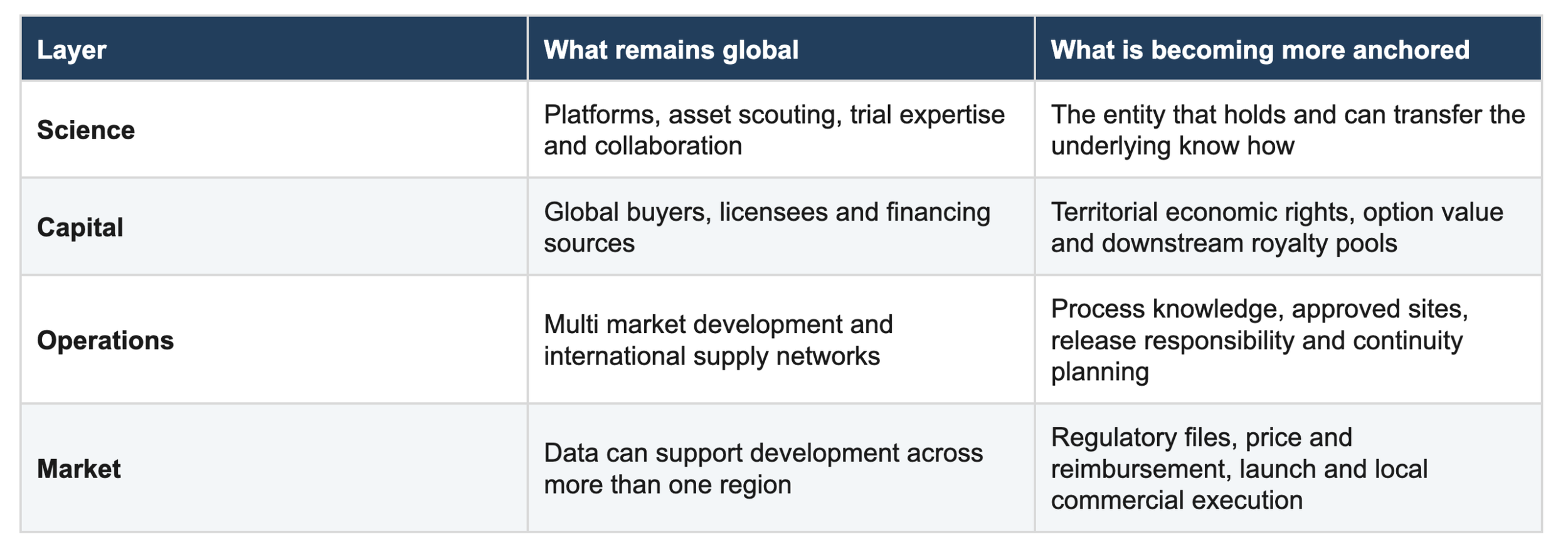
This is why an ex China license should not be read as a simple export of the asset. It may be a way to globalize development and capital while retaining a domestic franchise, operating leverage or future option. The opposite can also be true when an overseas company grants Greater China rights to a local partner. The question is not whether the molecule crossed a border. It is which parts of the asset stack crossed with it.
The Deal Terms Show the Change
Pfizer's agreement with 3SBio is a clean example. Pfizer received an exclusive worldwide license to SSGJ 707 excluding China, plus an option for China commercialization rights. [2] China was not treated as a residual territory. It was separately priced and separately controllable. The deal globalized the program while preserving a distinct China decision.
The Hengrui Aiolos GSK sequence shows how a NewCo can do the same thing. AIO 001 was licensed to Aiolos for development and commercialization outside Greater China. GSK later acquired Aiolos, but the acquired package still did not include the Greater China franchise. [3] A NewCo can therefore be a bridge to global capital and execution without being a full migration of the original asset or its home market value.
The reverse direction is just as important. Crescent granted Kelun Greater China rights to CR 001, while Crescent retained rights elsewhere. The filing describes initial supply, a data sharing framework, know how and manufacturing technology transfer, and reversion or license back mechanics. [4] This is not merely a local sales arrangement. It is an operating architecture for a deliberately divided asset.
Policy Is Changing the Payoff
The policy relevance is not that governments prohibit every cross border deal. More often, they change the payoff from retaining operational depth at home. The EU's provisional Critical Medicines Act agreement is designed to strengthen resilience and security of supply for critical medicines. [5] In the United States, Section 851 of the FY2026 defense authorization law governs specified Federal relationships involving covered biotechnology providers. [6] In China, payment and access measures for innovative drugs increase the economic relevance of the domestic commercial franchise. [7] These policies are different in purpose and scope, but their shared effect is to make control over supply, access and execution more valuable.
That does not make every territory split a geopolitical decision. It does mean that CMC, supply, local regulatory capability and reimbursement are no longer back office details. They are part of the strategic asset itself.
How to Read a Deal Now
For investors and business development teams, headline deal value is only the starting point. The stronger questions are:
What stayed behind. Who retains China or Greater China rights, and are those rights commercial, development, co development or only option based?
Who controls the operating stack. Who owns the regulatory dossier, critical data access, manufacturing know how and the ability to make post approval changes?
What happens if the relationship changes. Reversion, license back and change of control provisions show where leverage really sits.
What value is actually realized. Separate current cash from milestones and royalties, then ask who still owns the durable economics in the home market.
This avoids a common mistake in the China discussion. A licensed out asset is not automatically a lost asset. If China rights, supply leverage or a domestic launch option remain with the innovator, the transaction may finance global development without giving away the entire franchise. But that cannot be assumed. It has to be visible in the contract architecture.
The More Useful Forecast
Territorial licensing predates today's geopolitical tension, and the rise in China origin transactions also reflects stronger assets, global patent cliffs and constrained biotech financing. Our claim is therefore narrower than a story of nationalization. The test is whether deal terms increasingly separate regional rights, include more CMC and supply provisions, use regional NewCos, and protect reversion or change of control rights.
If that continues, cross border licensing may remain very active. What will change is the nature of the globalization it represents. The industry will continue to globalize science and capital, while increasingly regionalizing the right to supply, regulate, sell and capture the long term value of the asset.
Sources
1. J.P. Morgan Q3 2026 Biopharma Licensing and Venture Report. DealForma based market data through 30 September 2026.
2. Pfizer Enters into Exclusive Licensing Agreement with 3SBio. Primary disclosure of the SSGJ 707 territorial structure and China option.
3. GSK Completes Acquisition of Aiolos Bio. Primary disclosure of the AIO 001 license outside Greater China.
4. Crescent Biopharma Quarterly Report September 2026. SEC filing describing the Kelun territorial license and operating transition terms.
5. Council and Parliament Reach Provisional Deal on the Critical Medicines Act. The provisional agreement focused on resilience and security of supply; formal endorsement remained pending at the publication date.
6. Public Law 119 60 National Defense Authorization Act for Fiscal Year 2026. Primary statutory text. Section 851 governs specified Federal relationships involving covered biotechnology providers.
7. National Healthcare Security Administration Measures to Support Innovative Drugs. Official Chinese policy statement on payment and access support for innovative medicines.
